A Brief Overview of Dual Language Education
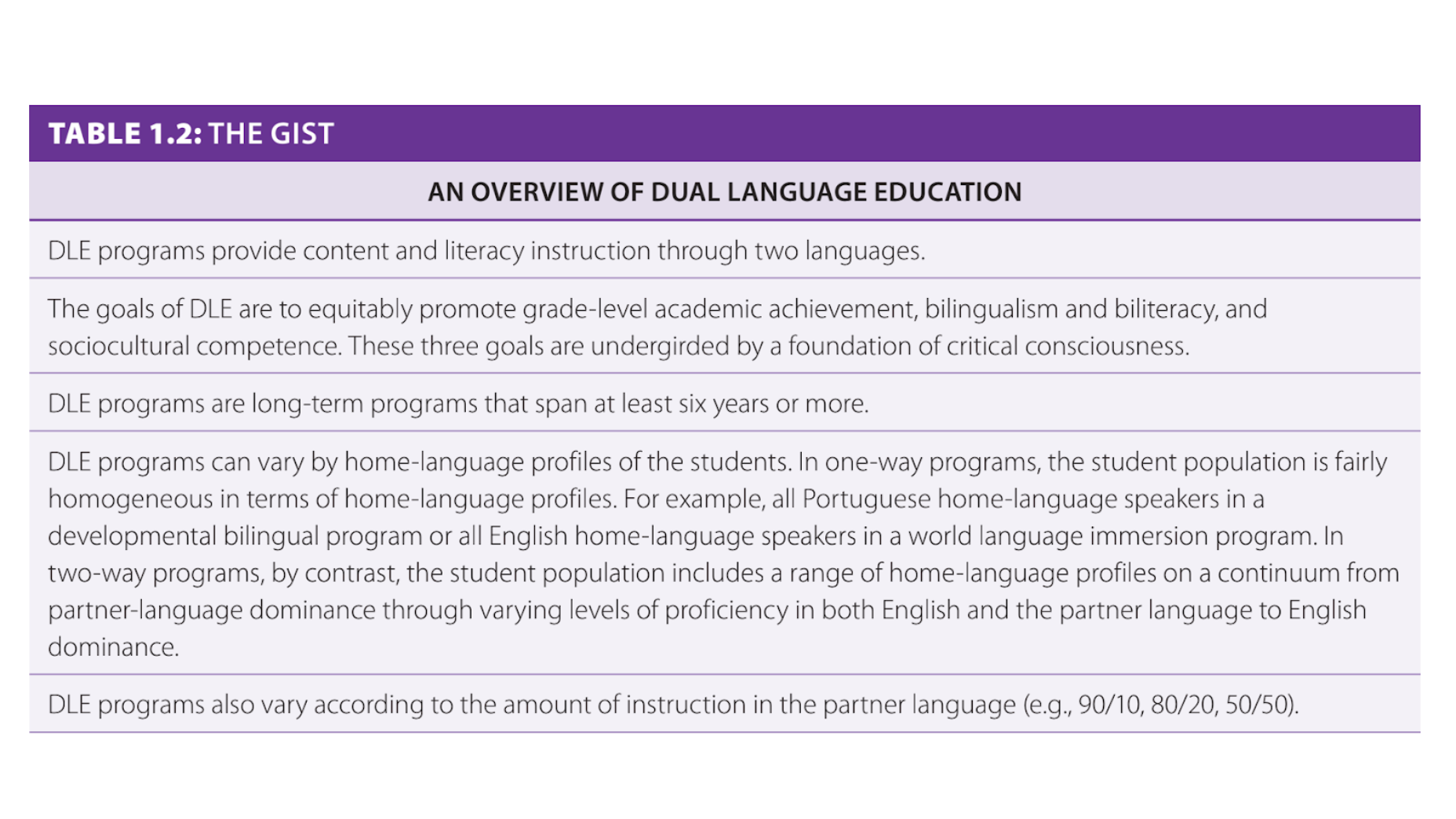
Jan 21, 2026For those who are new to dual language education (DLE), here are a few key concepts that have implications for the Tandem Teaching relationship (refer to The Gist in Table 1.2 below for just the highlights). First, all DLE programs deliver content and literacy instruction through two languages, aiming to foster grade-level academic achievement, bilingualism and biliteracy, and sociocultural competence(Howard et al., 2018). As we mentioned in the previous section, critical consciousness has been proposed as a necessary foundation for those three goals to be attained equitably (Freire, 2020; Heiman et al., 2024; Palmer et al., 2019). This framing aligns with the guiding sentence of the Dual Language Logic Model, which posits that DLE programs achieve “mission fulfillment through a continuous focus on academic achievement, bilingualism and biliteracy, and socio-cultural competence; supported by the school, home, and community; through a stance that prioritizes equity and social justice, fosters critical consciousness, and is anti-racist and culturally and linguistically sustaining” (Howard et al., 2021 in McCormick et al., 2021, p. 28).
Secondly, given that language acquisition is a slow process that takes several years to fully develop, all DLE programs are long-term initiatives spanning at least six years or more. Most DLE programs start in kindergarten, or increasingly in pre-K, and extend at least through the full sequence of elementary grades, preferably into the secondary grades as well. Due to the long-term nature of these programs, Tandem Teachers not only need to plan with each other but also have to plan for vertical articulation because the actions of teachers at one grade level have implications for teachers at subsequent grade levels. For instance, if the partner-language development of a group of students isn’t adequately developed in the primary grades, it can become exceptionally challenging for the upper-grade team to deliver the increasingly complex academic content via that language.
In addition to these commonalities, there are some defining characteristics by which DLE programs differ, particularly in terms of student population and the extent of instruction through the partner language. Regarding the student population, programs can be either one-way or two-way. In one-way programs, the student population is relatively homogeneous concerning home language profiles. For instance, all or most of the students may speak the partner language at home (developmental bilingual), speak mostly English at home but have extended family members who speak the partner language (heritage language), or speak English at home and have no family connection to the partner language (world language). By contrast, in two-way programs, the student populations are mixed by home-language profile, enrolling students who are dominant or monolingual in the partner language, those who are dominant or monolingual in English, and those on a spectrum of bilingual proficiency in the two program languages. The GP3 recommends that a two-way program should have at least one-third and no more than two-thirds of the population dominant or monolingual in each program language at the time of enrollment (Howard et al., 2018). From a Tandem Teaching perspective, these different models impose various types of responsibilities on the English and partner-language teacher. In a one-way developmental bilingual program, English teachers need to be highly skilled in sheltered instruction, while in a heritage language or world language one-way model, more emphasis is placed on the sheltering strategies of the partner-language teacher. In a two-way model, both the English teacher and the partner-language teacher must possess these skills to a high degree because, irrespective of the language of instruction, there will always be some students who are developing proficiency in that language, especially in the primary grades.
DLE programs also differ in terms of the amount of instruction in the partner language. In a 90/10 model (often implemented as 80/20 because of English specials), there is more partner-language instruction than English instruction in the primary grades, with ratios gradually shifting until a 50/50 ratio is reached by the third or fourth grade. In this model, the Tandem Teaching partnerships in the primary grades may look different from those in the upper grades, which are more likely to resemble a 50/50 model. A single bilingual teacher may provide instruction through both program languages, or there may be a designated English language development (ELD) specialist who partners with all of the classroom teachers to provide a short block of English instruction each day, or teachers may swap classes so that teacher A provides English instruction to teacher B’s class and vice versa.
Contrastingly, in a 50/50 model, equal amounts of instruction occur through both program languages at all grade levels. In this approach, it is very common for Tandem Teachers to share responsibility for two classes of students, with one providing instruction through English to both groups, and the other providing instruction through the partner language to both groups. This approach is also commonly used in the partner-language-dominant models described above when they reach the 50/50 instructional ratio in the upper elementary grades. In either case, it is also possible to have a single bilingual teacher who provides instruction through both languages. Although this book concentrates on the specific considerations required for coordinating instruction between two teachers, much of the content is still relevant for self-contained bilingual teachers.
Reprinted with permission from Howard & Simpson (2024) Dual language tandem teaching: Coordinating instruction across languages through cross-linguistic pedagogies.
PS...If you’d like to be notified when new blog entries are posted, subscribe to our mailing list below. Likewise, if you’d like to be part of a larger conversation about this topic, join our Facebook group Dual Language Tandem Teachers! We’ll have conversation prompts to stimulate discussion, and that’s also where we’ll announce new blog posts, upcoming presentations, and other related activities. We also invite you to like and follow us on Facebook and Instagram. ¡Adelante!
Let's stay connected!
We hate SPAM. We will never sell your information, for any reason.
